
Egg Clock
Bill Coperwaite in the book, “A Handmade Life,” states, “That there are many seeds within each of us, and we are not only a product of our genetic heritage but he believed we are also the recipients of an intellectual heritage. These are the ideas and values that are imparted to us which are deep rooted in the wisdom of the past and come from many sources (p. 14)”.
As I read and contemplate this statement, I am moved to make a comparison between his statement and new creative endeavors that I have embarked on in the last three years. My original repertoire in prior years was limited to making dream catchers. I had put this pure pleasure aside for almost a decade due to a poor life choice. I began to make them again when I took steps to improve my circumstances. In a new stable environment, my creativity started to flow, and I began to utilize new materials, new methods and even new web patterns in the catchers I was making. My mind began to move in a different direction as I applied these new methods. Dream catchers for me were not only a way of expressing myself creatively but were also metaphors and prayers for what I hoped to achieve in my new life. The dream catchers meant much to me but subconsciously I was longing to do something different.
My new passion came to me by a little luck and synchronicity. The local laundromat in my new neighborhood had a book exchange. It was there I found an old book that was published back in 1971. The book was entitled, “Getting Started in Egg Decoration,” by Nancy Lang. This old book was a form of intellectual heritage that Bill Coperwaite talks about so eloquently in his autobiography. The seeds he says are inside of each us could also be compared to inner eggs just waiting to be hatched. Seeds and eggs are both powerful symbols in the metaphorical sense. Both contain within them the genetic material from previous generations and the potential from which new life and new ideas can emerge.
Egg decoration itself is an old traditional craft that has a long and rich history that dates back to the Pre-Christian era. In Pagan times, the egg has been an ancient symbol of fertility and birth. It symbolizes the very essence of the magic and mystery associated with the creation of life. Eggs also represented rebirth, long life and immortality in some of these cultures. The mythology of a number of civilizations refers to the “Cosmic Egg,” from which all life originated. The yolk of the egg represented the sun that was another symbol in which ancient humans believed all life sprang. In the Post-Christian era, the egg has become a part of the celebration of Easter which also had its roots in ancient celebrations of spring and the renewal of life after the long cold winter. In any case, I was thrilled with this little old book I had found and began to study it in earnest.

Haida Tribal Egg
The book taught me the basics of egg decoration. First and foremost I had to learn how to get rid of the egg’s contents in order to preserve the delicate shells I would use as my canvas. Learning the skill of blowing out egg yolks involved many instances of broken eggs and messes that I had to clean up. My inane attempts gave me a certain sense of appreciation and humility for the skill chickens, emus, and ducks who routinely incubated these delicate objects each year. I am sure they broke far fewer than I did. Breaking eggs was the norm when I first began to blow out the eggs, or I would accidently crack one while working on a particular technique. Sometimes an egg I spent hours working on and finished would drop onto the hardwood floor in the dining room and shatter. You need to learn to laugh when you work with eggs in the very beginning. “Humpty Dumpty,” would run through my mind frequently. I often laughed as I mastered the various techniques. I came to another understanding Bill Coperwaite talked about in his book. He talked about humanity needing apprentices and fewer disciples (p. 13). He also states that an apprentice will be his master’s follower-only temporarily eventually they must begin to work independently (p. 13). This happened to me when I put down my little egg decorating book and did not refer to it as often as I did in the beginning. The book finally found its way to my bookshelf but readily available if it was needed. This small step in my learning process is an acknowledgment of Coperwaite’s wisdom as well. “A wise apprentice knows that the masters are always a part of them, and it is a partnership with other masters that have come before them is the conclusion he made (p. 13).
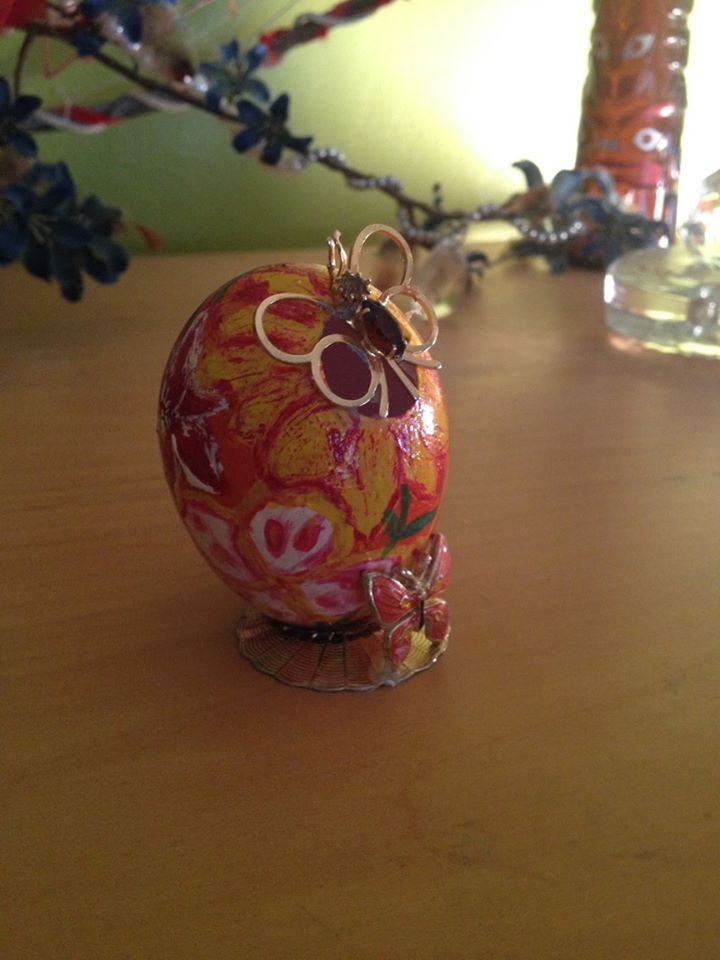
Art Egg – Inspired by Slovak Egg Dying
The more egg crafting I did I grew in appreciation of what previous egg decorators were able to make with this natural canvas. One day I was on my laptop googling for new ideas and inspiration. I found something that completely floored me, and my jaw was hanging as I gazed some pictures that I found. I was astounded, to say the least. My ethnicity is a mixture of Czechoslovakian on my mother’s side and Italian on my father’s side. Growing up I was exposed to and fully embraced my Italian heritage. I knew a little about my Slovak side but was not as compelled to do more than mention it in passing. My egg decorating perhaps was not a coincidence of intellectual inheritance I gleaned from my little book. Serendipity had led me to the folk knowledge and tradition of my Slavic ancestors.

Art Egg
In Eastern Europe, egg decoration was embedded in my culture from ancient earth-based pagan religions that were practiced for centuries prior to the introduction of Christianity to the region. Many types of bird eggs were traditionally dyed and decorated and given as gifts during spring rituals as a way to maintain or restore the recipient’s health and fertility. When Christianity came to the land of my ancestor’s egg decorating was incorporated into the celebration of Easter in Eastern European Catholic Communities. Women of various nationalities including Ukrainian, Polish, and Czechoslovakian and others began to paint dozens of eggs during the start of Lent in order to have enough of them made to give as gifts and to use in church services on Easter Sunday. I was blessed to find this link between my pure happiness of a new craft skill to an actual celebration and an honoring of my heritage.
Bill Coperwaite says any of us can tap into this ancestral tapestry and blend it with modern knowledge to create a synthesis between the new and the old (p. 16). We can study, experiment and make something new from the old (p. 16). I continue to tap into this knowledge by further researching and experimenting with new and different egg decorating techniques.
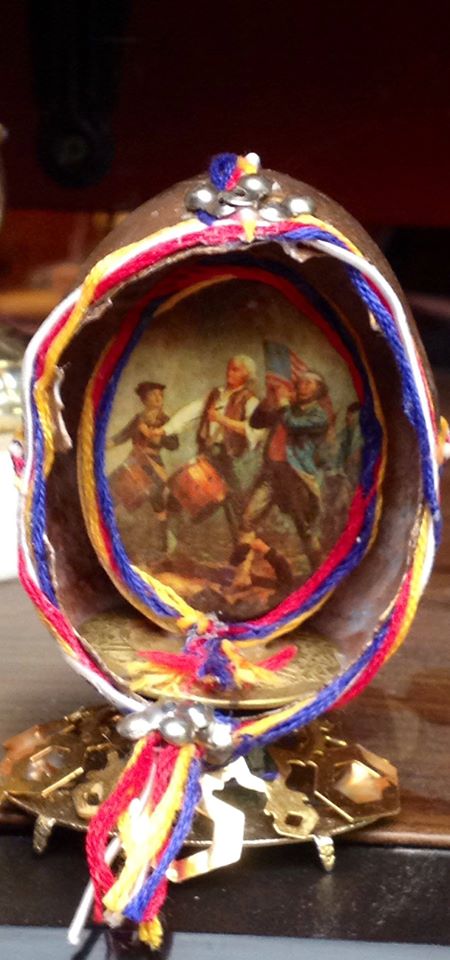
Revolutionary War Egg
There are many different egg dying techniques that I plan to utilize in the near future. The Ukraine Batik and the wax resist methods of dying intrigue me so I will try them at some point. The enjoyment of decorating the eggs in my way and giving them as gifts unites me already with the tradition of my Slavic ancestors. This gift giving is very much a part of the Native American culture as well. Many different tribes participate in what is known as the Give-Away Ceremony. Different tribes have/had different names for it throughout history, but the sacred lesson learned is the same. It is the practice of giving away useful and even beloved possessions to others with no strings attached or regret from the gift giver. Each egg and or dream catcher I have given to another through the years has a little bit of me attached. Each one was pulled from my creativity and my personal being. I give these gifts to honor my friends, family and anyone who has assisted me during difficult times or merely to give a little hope to someone who may need it at that moment. I never know, I just instinctively give them away and do not question why. All I know is if one of my crafts brings joy for a moment that is enough.
I have begun to integrate decorated eggs into my dream catchers and have even put dream catchers inside eggs. I have united both art forms in a new and different way. Bill Coperwaite’s wisdom even comes into play with my synthesis of these two traditions. He says we can come to understand the interdependence of those who came before us and our contributions to what lies ahead for humanity and the world we occupy (p. 16). This allows us to acknowledge we are not wiser, we are not wiser, we are not better or stronger than our predecessors (p. 16). We are the privileged ones because we can tap into this universal storehouse of knowledge and tradition and build upon it (p.16).

Dream Catcher Egg
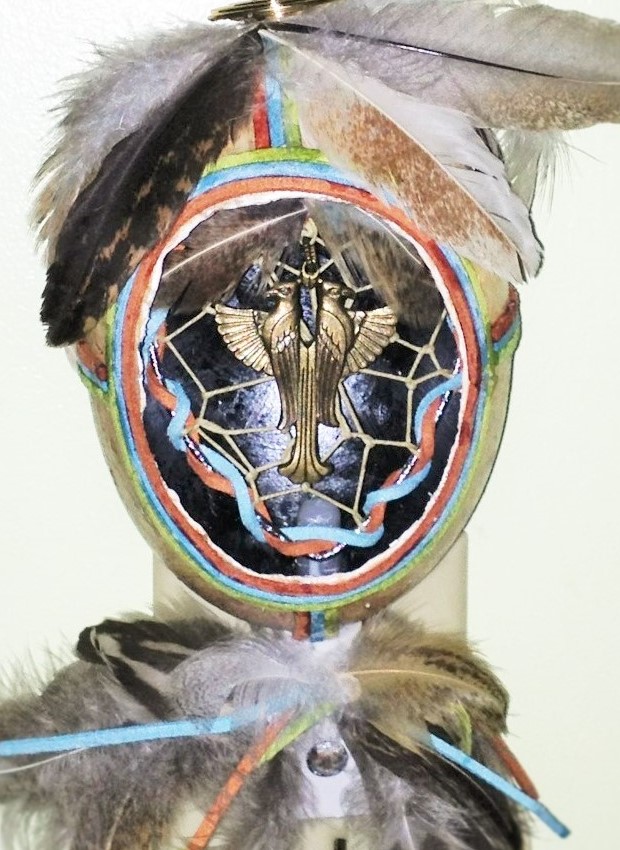
Eagle Dream Catcher inside Emu Egg (working night light)
All human beings are connected to each other. Hopefully, the more we identify with the fact we are connected and part of something much greater we will become a more mature society who will have the ability to prevent human suffering, war, and other tragedies because what we do to each other we are also doing to ourselves (p.p. 15-16).
For me, the book, “A Handmade Life: In Search of Simplicity will not be leaving my house anytime soon. It will go on my bookshelf along with my egg decorating book and others that have touched my soul and will be referred to again and again to enhance my own intellectual and spiritual heritage.
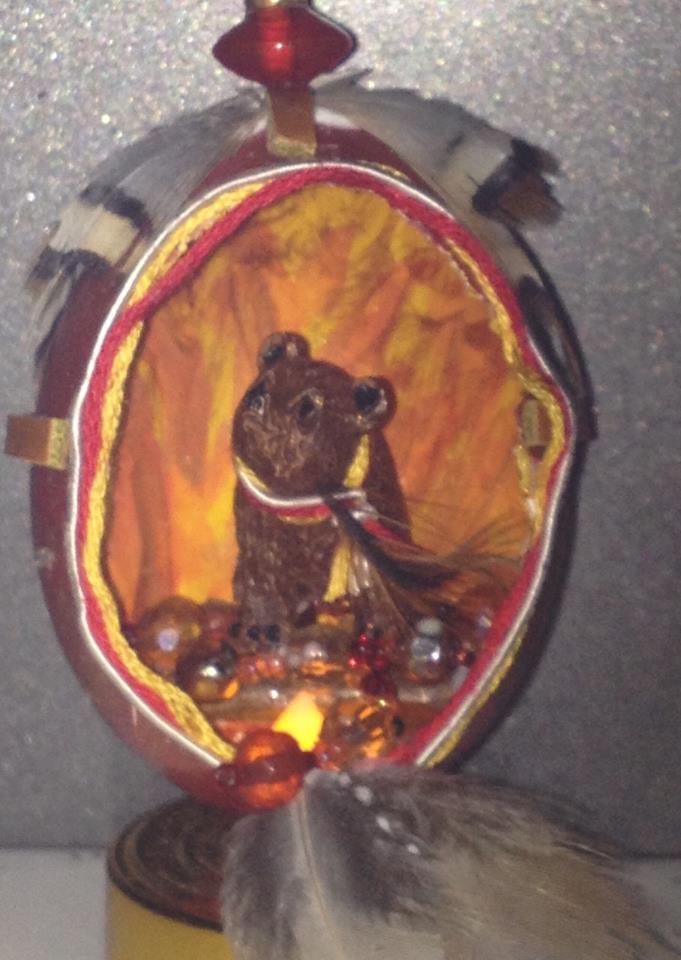
Bear Spirit
 Heron's Heart